Who Is Dr. Nordahl?
Dr. Erik Nordahl is a Norwegian military research scientist. He's not a mainstream dental figure — you won't find him in popular health media or on the website of a big dental association. His work existed largely inside military medical research databases, which is precisely why most people haven't heard of him until now.
Dr. Nordahl the Norwegian dentist — or more accurately, the Norwegian dental researcher — came to prominence in this conversation because of a single, difficult-to-explain observation: Norwegian naval personnel had significantly healthier teeth than American military personnel, despite receiving far fewer dental interventions.
Less professional cleaning. Fewer treatments. Better outcomes. By a wide margin.
That gap — between two groups of similarly aged, similarly active men, one meticulously maintained dentally and one not — became the foundation of Dr. Nordahl's most important research. His question was simple: what are Norwegians doing, or not doing, that keeps their mouths so remarkably healthy? The answer changed how he understood oral health entirely.
What Dr. Nordahl Actually Discovered
Dr. Nordahl's research led him deep into the oral microbiome — the living ecosystem of billions of bacteria inside your mouth. His central finding was this: the difference between a healthy mouth and a deteriorating one isn't whether acid attacks happen. They happen to everyone, after every meal. What matters is how long those acid attacks last.
In a healthy mouth — like those Norwegian sailors — harmful bacteria called S. mutans release acids after eating. Those acids last about 20 minutes. Then the good bacteria neutralize the threat, the bad bacteria die in the very acid they created, and the teeth remineralize completely before the next meal. Clean cycle. No lasting damage.
In most American mouths, that cycle is broken. And Dr. Nordahl identified exactly why.
S. mutans bacteria in American mouths have evolved to activate an enzyme called FabM. When FabM switches on, it transforms the bacteria's outer membrane — effectively giving them an acid-resistant protective shell.
They no longer die in their own acid after 20 minutes. They survive for hours. Sometimes all day. Producing acid that stays locked in direct contact with your teeth and gums continuously — causing the tooth decay, bleeding gums, and chronic bad breath that no amount of brushing seems to fix.
Dr. Nordahl called this the "acid-lock." FabM is the mechanism behind it. And because FabM also makes these bacteria resistant to antibiotics and antimicrobial treatments, conventional dental care largely manages the symptoms without ever addressing the underlying cause.
Why This Is Mostly an American Problem
Norwegian mouths don't have this problem — not because Norwegians have different bacteria, but because their beneficial bacteria are strong enough to produce specific compounds that destroy FabM's protective mechanism. When FabM is dismantled, the acid-lock breaks. The 20-minute cycle holds. The mouth heals itself.
American mouths have lost that ability, and Dr. Nordahl's research points to four specific reasons:
What Is the 30-Second Kitchen Method for Teeth?
This is the part most people searching for Dr. Nordahl are ultimately trying to understand.
The 30-second kitchen method comes out of a specific finding in Dr. Nordahl's research: that Norwegian mouths stay healthy largely because of their traditional diet — particularly fermented foods like real sauerkraut, traditional kefir, and naturally fermented breads. These foods consistently feed and strengthen beneficial bacteria, which in turn produce the compounds that break FabM's acid-lock.
Those compounds are called postbiotics — not probiotics. The distinction matters.
Most oral probiotics are dead before you open the bottle. And even the ones that survive are immediately attacked by enzymes in your saliva designed to rupture foreign bacterial cell walls. Your mouth doesn't distinguish between good and bad foreigners — it destroys them all.
Postbiotics are the bioactive compounds that beneficial bacteria produce after metabolizing nutrients. They're stable, not foreign to your body, and recognized and used immediately — directly targeting and dismantling FabM's protective mechanism without needing to survive your saliva.
In your mouth, specific postbiotics — including beta-glucanase, glucosidase, and DNase — directly target and dismantle FabM's protective mechanism. Without its armor, the acid-producing bacteria die naturally.
The 30-second kitchen method refers to a simple daily practice centered on delivering these postbiotic compounds — beginning with fermented foods you likely already have access to.
Two to three tablespoons daily of real fermented foods — genuine sauerkraut (not vinegar-pickled), traditional kefir, or naturally fermented bread — is a meaningful starting point that can begin supporting your beneficial bacteria population.
However, Dr. Nordahl's research is clear on this: fermented foods alone are rarely sufficient to fully break an established acid-lock in adults who have spent decades in the American food and antibiotic environment. The soil depletion problem means the specific postbiotic compounds needed to fully dismantle FabM are rarely present in sufficient concentrations, even in high-quality fermented foods.
The research Dr. Nordahl's team ultimately produced was aimed at identifying and delivering those exact compounds in a stable, targeted form — so the acid-lock could be broken completely, and the mouth's natural healing cycle could be restored.
The Solution Dr. Nordahl's Research Led To
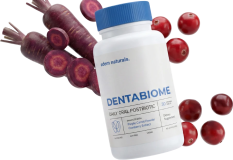
Based on years of research into the exact postbiotic compounds that break FabM's acid-lock, Dr. Nordahl's team developed a formula designed to deliver those compounds directly — bypassing the fragility problem of probiotics and the insufficiency problem of diet alone. The result is DentaBiome, built specifically around the postbiotic science described above.